How Many Personal Training Sessions a Week Do You Need?
Choose a realistic PT schedule, understand what changes to track and learn when to maintain, increase or reduce your weekly training.

Two or three personal training sessions a week can be a useful starting point to discuss with a coach, depending on your schedule, goals and need for guidance. Two appointments may be easier to maintain when work is busy or you also play sport. Three provide more opportunities for supervised practice. Neither is a mandatory number or a guarantee of results within a fixed period.
As for how long results take, first define the change you are looking for. Learning to use equipment, moving with more confidence, lifting heavier weights and changing your physique are different forms of progress. You may feel more independent in the early weeks, while visible body-composition changes generally need to be assessed over a longer period.
Even two people with the same fat-loss goal may need different schedules. An office worker who is currently inactive and has three free evenings should not automatically follow the same plan as someone who already plays tennis several times a week. A useful PT schedule connects your goal with everyday life, leaving enough capacity to train, recover and keep going.
Look at your whole week before choosing a PT frequency
The number of coached sessions and the total number of workouts are different. You might see your coach twice and complete another planned session independently. Alternatively, three PT appointments might cover all your weekly strength work, with other days reserved for walking, ordinary daily activity and rest.
Two PT sessions, two tennis sessions and a run already make five planned activities. Their demands are not identical: an easy hit differs from a long match, just as a relaxed run differs from your weekend long run. Your coach needs to understand the duration, effort and timing of each activity to arrange gym work appropriately.
Describe a typical week, including late working days, sports, travel time and appointments you can reliably keep. Mention busy periods at work so the plan can adapt instead of being designed around your quietest week. This planning and adjustment is part of the value of one-to-one personal training; the number of sessions is only one decision within it.
Two, three or four sessions: what changes?
Before adding appointments, ask whether you need more training time or more instruction. Someone learning unfamiliar movements may need closer supervision. An experienced lifter may need additional training volume but be able to complete some of it independently. These needs can lead to different combinations of PT and self-directed sessions.
| Coached sessions per week | When to consider this | What to clarify |
|---|---|---|
| Two | A busy schedule, a new habit, a limited budget or other regular sports | What happens between appointments and what you can do independently |
| Three | Regular guidance and three reasonably dependable time slots | Attendance, recovery and how work is distributed |
| Four | A program spread across more days or supervision for more of your training | The purpose of the extra session, total workload, time and cost |
Two sessions can be a practical starting point
Two regular appointments can provide structure while leaving room for work and family. For a beginner, consistent instruction creates opportunities to learn equipment setup, practise movements and start recording progress.
Agree on what happens between appointments. If you are not confident training alone, your coach needs to know. A two-session package should not assume you can also complete a complicated independent workout at the weekend. As your skills develop, you can discuss adding familiar exercises you can perform reliably. Our beginner's guide to the first weeks of gym training explains some of those foundations.
Three sessions offer more supervised practice
Three reliable appointments provide more opportunities for feedback and allow your coach to distribute exercises across the week. Their value depends on being able to attend consistently, however.
Suppose you plan three sessions weekly for four weeks: 12 appointments. If work commitments mean you attend only eight, the first issue to address is scheduling. Making each workout harder to compensate does not solve the underlying problem. Two appointments you can keep may be the better foundation during that period, with a third added later for a clear purpose.
Four sessions should have a specific role
Four coached sessions may suit a program that spreads its priorities across more days or a client who wants supervision for most workouts. The coach can give different sessions different focuses rather than fitting everything into one long appointment.
Moving from two to four sessions does not make results arrive twice as quickly. Total workload, movement quality, recovery and affordability still matter. If the extra appointments repeatedly reduce your sleep or require last-minute changes, their practical value may be limited.
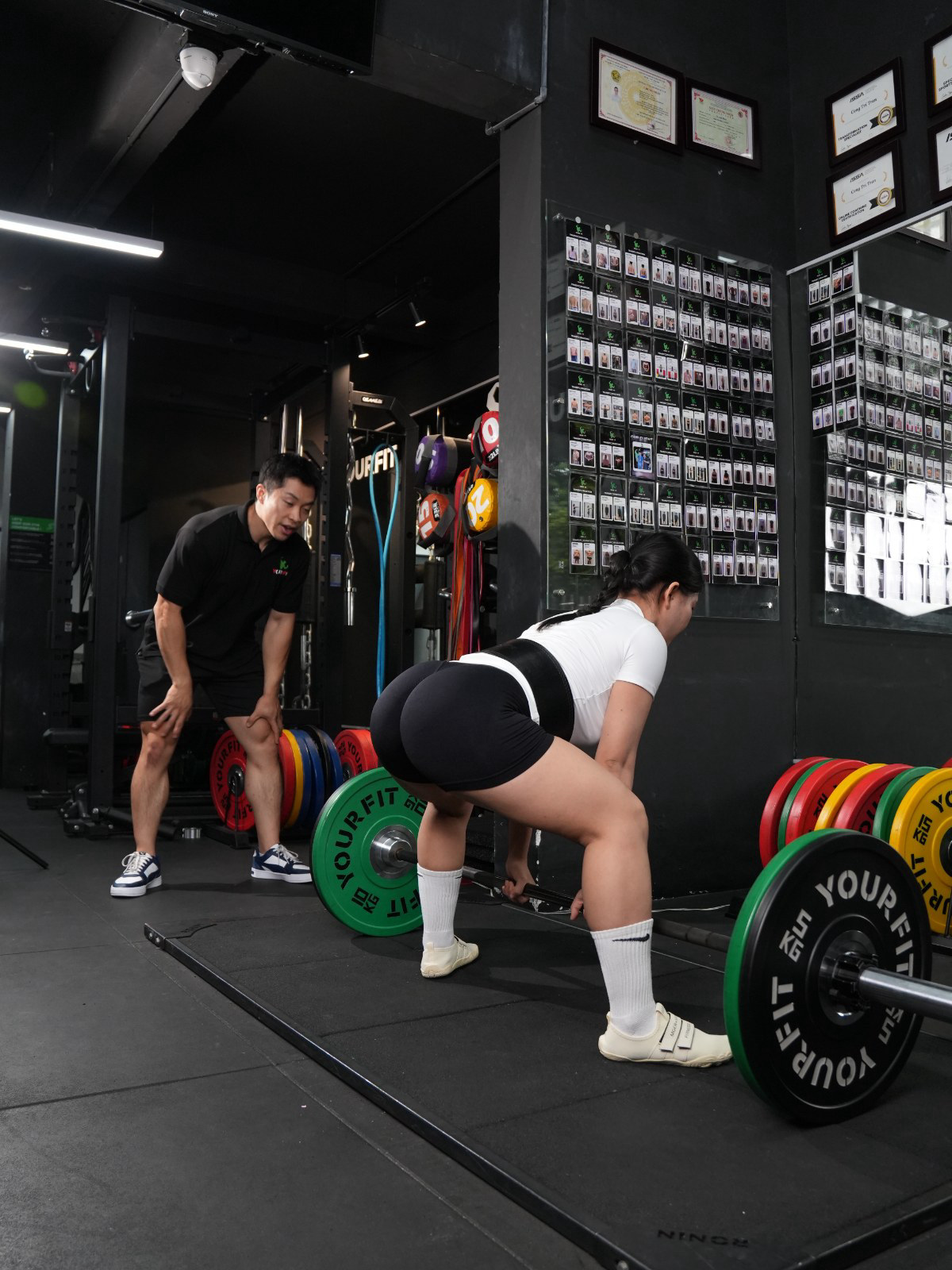
YourFit describes a typical PT session as around 60 minutes. Allow for travel and preparation as well. Understanding what happens during a one-to-one PT session makes it easier to decide how many appointments fit your week.
How should your goal influence the schedule?
Fat loss: connect gym sessions with everyday habits
Adding PT is only one possible adjustment when fat loss is your goal. Eating habits, movement outside the gym, sleep and consistency also affect the program. A focused hour of training needs to be considered alongside the rest of the week: are you sitting for most of the day, regularly missing meals or struggling to recover between commitments?
Strength work can remain part of a body-composition program. A fat-loss session does not need to become continuous cardio simply to produce more sweat. Exercises, loads and additional activity should reflect your needs and ability.
Body Transformation at YourFit presents three to four private coaching sessions as a reference schedule, alongside appropriate independent activity. This is a program example, not a minimum for everyone seeking fat loss. If you can reliably attend only twice, explain that at the outset so expectations and the plan are realistic.
Muscle and strength: consider both workload and execution
Counting gym days alone tells you little about a strength program. Two three-day schedules can differ substantially in exercise selection, sets, loads and progression. A beginner may need more instruction on setup and choosing weights; an experienced lifter may need detailed feedback on key lifts or a review of a plateau.
Strength & Technique Training suggests two to four coached sessions weekly. If you want to combine PT with independent training, discuss which exercises need observation and which you can manage alone. Both parts should belong to one coordinated plan.
Tennis, pickleball and running: plan around your main sport
Share your sports schedule before choosing PT days. An important match, a long technical session or a weekend long run should influence where strength work sits. If Sunday is your key running day, the timing and volume of leg training need to reflect that priority. A competition or increase in court time may also require changes to gym work.
Sports Performance at YourFit uses two supplementary gym sessions a week as a reference alongside your main sport. It develops physical capacity; sport-specific technique remains part of your own practice or work with a specialist sports coach.
Training after 40: start from your current foundation
Age is relevant, but it cannot determine frequency by itself. Someone who has stayed active for years may need a different introduction from someone returning after a long break, even if they are the same age.
Two sessions can be a starting point to discuss while you relearn movements and observe your response. Sleep, workload, technique and how comfortably you manage daily activities are more useful than chasing a high session count. Active Strength 40+ presents two to three private or partner sessions alongside appropriate lighter activity. Relevant medical advice should inform the plan if you have a health condition or persistent pain.
Should you train with a PT five or six times a week?
Higher frequencies can have a place in a specific plan, but they should not be the default starting point for a recreational trainee. Before choosing five or six appointments, ask what each session will do and why the program needs that frequency.
More gym days do not have to mean more hard workouts. A plan can distribute strength, technical practice, supporting exercises and lighter activity across the week. Consider the total demand alongside your recovery and available time.
If you already attend consistently and are progressing, another person's fuller schedule is not a reason to add sessions. If you are regularly exhausted, movement quality is declining or important commitments are being displaced, review the arrangement. A well-explained plan gives every session, and every rest day, a purpose.

How long does personal training take to show results?
Evaluate different forms of progress separately. More confident movement, reliable attendance, increased strength and changing measurements do not necessarily arrive together. Agree on review points rather than a deadline by which your body must change.
Weeks 2–4: is training fitting into your life?
An early review can check whether appointments are realistic, exercises match your current ability and basic instructions make sense. You might feel less hesitant adjusting a machine, remember how to prepare for an exercise or describe what you find difficult more clearly.
These changes are less dramatic than a scale reading, but they support the next stage. If you are still missing appointments or do not understand the exercises, adjust the schedule or teaching approach. You do not need to wait until a long package ends to say a time slot is unmanageable.
Around weeks 6–8: look for training trends
Once several sessions have been recorded, compare technique, load, repetitions and your response under reasonably consistent conditions. Better control with the same weight or more consistent repetitions can be meaningful. A higher weight with a substantially shorter movement tells a different story.
This is a useful point to discuss the next focus. Some people continue unchanged; others need more technical practice or a workload adjustment before considering extra days.
Around weeks 8–12 and beyond: review the broader goal
For physique goals, you might choose an eight-to-twelve-week review of the information agreed at the start: measurements, weight trends, optional photographs, training performance and consistency. This is a review appointment, not a promise of a visible transformation within that period.
Some goals require many months and ongoing adjustments. You also do not need to wait for a scheduled review if something is clearly wrong, such as repeated discomfort, an unmanageable timetable or disagreement about how progress should be measured.
What should you track?
Choose a few measures that help you make decisions. Beginners may start with completed appointments and confidence using basic equipment. Strength-focused trainees need records of loads, repetitions and execution. Body-composition measures should be considered alongside activity and habits.
Keep comparisons reasonably consistent. Different lighting and camera angles can make progress photos misleading, while weight increases are difficult to interpret without considering technique. Agree on what to record, how often and how it will be used.
A useful review question is, “Where am I progressing with this schedule, and what problem is the next change intended to solve?” The answer should be more specific than simply being told to try harder.
Three weekly schedules to discuss with your coach
These are examples of arranging appointments, not ready-made exercise prescriptions. The exercises and workload still depend on your starting point and response.
| Situation | Illustrative coached schedule | Remaining days |
|---|---|---|
| Busy with work and building a habit | Tuesday and Friday | Maintain daily movement; add independent work only when agreed |
| Seeking frequent guidance | Monday, Wednesday and Friday | Allow for recovery and suitable lighter activity |
| Already playing sport regularly | Two days selected around the main sport | Identify important practices, runs and competitions first |
With two sessions, clarify the work between appointments
Tuesday and Friday provide two clear anchors. Other days might involve ordinary activity, walking or an agreed independent session. If extra training is assigned, ask which exercises to do, what load to start with and what feedback to report. A manageable plan you understand is more usable than a long list you are unsure how to perform.
With three sessions, leave room for real life
Monday, Wednesday and Friday are examples, not required days. Choose times that fit both your schedule and your coach's. Include travel, meals and other responsibilities in the calculation. If three evening appointments leave you constantly rushing, a mix of mornings and evenings, or temporarily returning to two sessions, may be more practical.
With other sports, identify the priority sessions first
Mark the demanding or difficult-to-move sessions before assigning gym days. Your coach can then choose suitable timing and content. This arrangement may change around competitions or increased sports volume; the objective is for the different parts to support one another.
When should you maintain, increase or reduce training?
Maintain the current schedule when you attend reliably, execute exercises better and manage daily life comfortably. Becoming accustomed to two sessions does not automatically mean you must progress to three or four.
Consider another session when it solves a defined need: more time to learn a skill, distributing work that is too concentrated or addressing an additional goal. Decide what the new session will contain and when you will review its value.
If performance declines repeatedly, soreness disrupts ordinary activities or recovery is consistently worse, discuss the whole picture. Sleep, work, food and sport all matter. These signs have several possible causes and do not establish an overtraining diagnosis. Your coach may adjust load, sets, exercises or frequency; persistent pain or unusual symptoms may require medical assessment.

Combining PT and independent training
You do not need a coach at every gym visit once you can perform parts of your program independently. Two PT sessions might focus on key movements requiring observation, while another session covers familiar supporting work. All three should remain part of the same plan, rather than adding random exercises whenever you have spare energy.
YourFit PT packages include corresponding Membership during their validity, subject to applicable access. If you want to move towards self-directed or small-group training, compare the Membership and Hybrid options.
Budget using the sessions you can actually attend. Over four weeks, two weekly appointments mean eight sessions, three mean 12 and four mean 16. These are four-week calculations, not a claim that every calendar month has exactly the same number of appointments. Check the total package price, expiry and scheduling conditions as well as the per-session rate. Our guide to comparing personal training costs explains the questions to ask.
What should you discuss before committing?
Prepare your main goal, the appointments you can reliably keep and the areas where you need the most help. You might want fat loss despite regular travel, or feel comfortable on machines but uncertain with free weights. Ask why the proposed frequency fits, what to do on non-PT days and when you will review it.
You can also explore YourFit's coach profiles. Beyond expertise, assess whether you understand the explanations, feel comfortable asking questions and can maintain a workable schedule together.
Frequently asked questions
Is one PT session a week worth considering?
It can be, particularly when you need help learning specific skills and organising independent work. Clarify whether the rest of the plan is realistic for your ability. One coached appointment plus appropriate independent activity is different from only exercising once all week. Explain your budget so the starting plan is practical.
Can I train only on Saturday and Sunday?
Discuss a plan for consecutive days. Your coach needs to consider exercise selection, loads and priorities, especially if you are a beginner or play other sports. Both days do not automatically need to be demanding full-body workouts to compensate for a busy week.
Should I make up a missed session immediately the next day?
Ask how to rearrange the program before compressing the schedule. Depending on what was missed, the work may move, be redistributed or continue at the next appointment. Repeated make-up sessions suggest the regular timetable needs attention. Rescheduling also depends on your package conditions.
Can I reduce PT once I know how to train?
You can consider less supervision when you understand the plan, perform independent work reliably and know when to ask for help. Agree on how progress will still be monitored. Our comparison of Membership, Hybrid, partner and one-to-one training can help you evaluate the next step.
Begin with a schedule you can maintain
Choose your PT frequency around dependable time, the support you need and your entire activity week. Attendance, movement quality and recovery then provide evidence for keeping or changing the schedule. You do not need an unusually busy timetable to demonstrate commitment.
If you are considering coaching at YourFit, review the Personal Training 1:1 and 1:2 options and discuss how they fit your schedule and budget.